

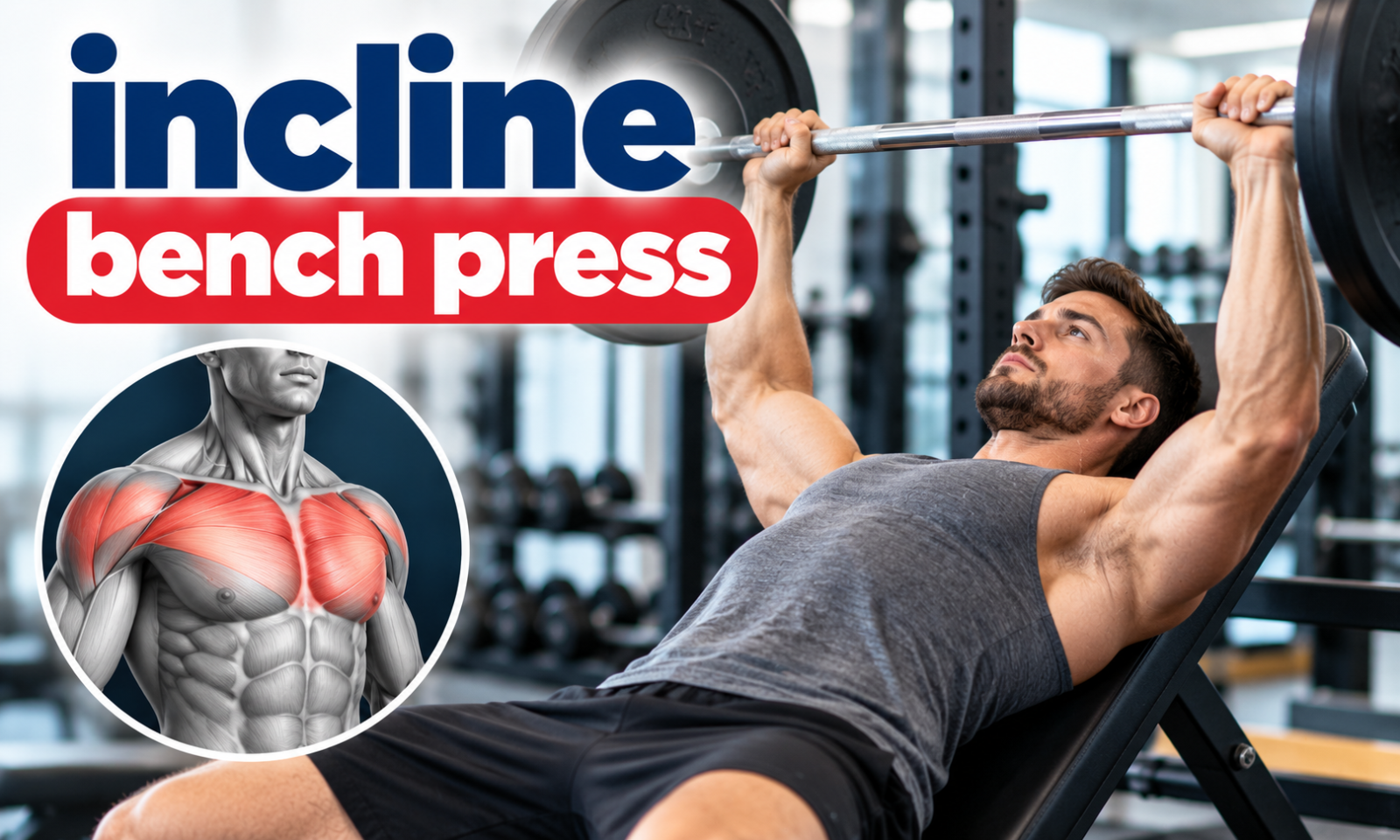
The incline bench press is a compound upper-body exercise that primarily trains the chest, shoulders, and triceps. Compared with a flat bench press, raising the backrest shifts more of the work toward the clavicular, or upper, portion of the pectoralis major while also increasing the contribution of the front deltoids.
For most lifters, an incline of about 15 to 30 degrees is a practical starting point. Healthline’s comparison of incline and flat bench pressing notes that a modest incline can emphasize the upper chest without turning the movement into a shoulder-dominant press. The best angle and load still depend on your shoulder comfort, training history, and goals.
What Muscles Does the Incline Bench Press Work?
The incline bench press is not an isolation exercise. Several upper-body muscles work together to move and stabilize the weight. The pectoralis major produces much of the pressing force, especially its upper fibers. The anterior deltoids help flex the shoulder, and the triceps extend the elbows as the bar or dumbbells move upward. Smaller stabilizers around the shoulder blade, rotator cuff, upper back, and core help keep the movement controlled.
| Muscle | Role | How Incline Changes the Emphasis |
| Upper pectoralis major | Main pressing muscle | Usually receives more emphasis than during flat pressing |
| Middle/lower pectoralis major | Assists the press | Still active, but generally less dominant as the bench angle rises |
| Anterior deltoid | Raises and presses the upper arm | Contribution increases as the incline becomes steeper |
| Triceps brachii | Extends the elbow | Works throughout the press at most bench angles |
What Is the Best Incline Bench Angle?
A moderate incline is usually the best place to begin. In a PubMed-indexed study comparing five bench angles, upper-chest muscle activity was highest at 30 degrees, while steeper angles produced substantially more anterior-deltoid activity. That does not mean 30 degrees is mandatory for everyone, but it supports using a relatively low incline when the goal is to emphasize the upper chest.
If your adjustable bench does not list degrees, use the first or second incline setting above flat and assess how the movement feels. A very steep setup, such as 45 to 60 degrees, begins to resemble a shoulder press and may reduce how much the chest contributes.
| Bench Angle | Typical Emphasis | Best Use |
| 0° | Balanced chest emphasis | Flat bench strength and general chest development |
| 15° to 30° | Upper chest with moderate shoulder involvement | Most incline bench press training |
| 45° | More shoulder involvement | Variation for lifters who tolerate it well |
| 60°+ | Shoulder-dominant pressing | Usually better classified as a high-incline or shoulder press |
How Do You Perform the Incline Bench Press Correctly?
Good setup matters more than chasing heavy weight. Use a rack with safety arms when possible, and use a spotter for challenging barbell sets.
- Set the bench to roughly 15 to 30 degrees and position it so the bar is above your upper chest when unracked.
- Plant both feet firmly on the floor. Keep your buttocks and upper back in contact with the bench.
- Pull your shoulder blades gently back and down. Maintain a natural arch in the lower back rather than flattening or exaggerating it.
- Grip the bar slightly wider than shoulder width. Keep the wrists stacked over the forearms instead of allowing them to bend far backward.
- Unrack the bar with control and move it over the upper chest.
- Lower the bar slowly toward the upper chest while keeping the elbows about 30 to 60 degrees from the torso. Avoid flaring them straight out.
- Lightly touch or stop just above the chest, depending on your mobility and equipment, then press upward and slightly back toward the rack.
- Finish with the elbows extended but not aggressively hyperextended. Keep the shoulder blades stable throughout the rep.
Barbell or Dumbbells: Which Is Better?
Both versions are useful. A barbell usually allows heavier loading and makes progression easy to measure. Dumbbells require each arm to work independently, offer more freedom to adjust wrist and elbow position, and may feel more comfortable for some shoulders.
Beginners can use either option, but dumbbells are often easier to learn when a spotter is unavailable. Advanced lifters may use both across the week, for example a heavier barbell incline press followed by lighter dumbbell work.
Incline Bench Press vs. Flat Bench Press
Neither variation is universally superior. Flat pressing tends to distribute work across more of the chest, while incline pressing shifts emphasis toward the upper chest and shoulders. Longer-term research also suggests that both horizontal and incline pressing can improve pressing strength, with some evidence of greater upper-chest growth from incline training.
For balanced chest development, many lifters benefit from using both rather than replacing one with the other. A simple weekly plan might include flat bench pressing on one day and incline pressing on another, or performing one as the main lift and the other as a secondary movement.
How Many Sets and Reps Should You Do?
The right prescription depends on your goal and training experience. Choose a weight that lets you keep the same technique from the first rep to the last. Stop the set when form begins to break down rather than forcing extra repetitions.
| Goal | Sets | Reps | General Approach |
| Strength | 3 to 5 | 3 to 6 | Heavier load, longer rest, precise technique |
| Muscle growth | 3 to 4 | 6 to 12 | Moderate load with controlled reps |
| Muscular endurance | 2 to 3 | 12 to 20 | Lighter load and consistent tempo |
| Beginner practice | 2 to 3 | 8 to 12 | Light load while learning setup and control |
US physical-activity guidance recommends muscle-strengthening activity for all major muscle groups on at least two days per week. The CDC’s adult activity guidance can be used as a general baseline, although your exact chest-training frequency may vary with your program.
Common Incline Bench Press Mistakes
- Setting the bench too high: A steep angle can make the exercise more shoulder-dominant than chest-focused.
- Flaring the elbows: Keeping the elbows closer to a 30 to 60 degree angle from the torso is often more comfortable for the shoulders.
- Bouncing the bar: Use a controlled descent and avoid using the rib cage as a rebound surface.
- Lifting the hips: Keep the hips on the bench. If the load forces them upward, reduce the weight.
- Losing wrist position: Keep the wrist stacked over the forearm to transfer force efficiently.
- Using too much weight: Heavy loading that shortens the range of motion or changes your bar path usually reduces training quality.
Can the Incline Bench Press Build the Upper Chest?
Yes, it can help develop the upper portion of the pectoralis major, especially when used consistently with progressive resistance and enough recovery. However, muscle growth does not come from angle selection alone. Total weekly training volume, effort, nutrition, sleep, and gradual increases in training demand all influence results.
You also do not need to use an extreme incline to target the upper chest. Research comparing angles generally supports moderate inclines, while higher angles increasingly shift work toward the shoulders.
How Can You Progress Safely?
Progress can come from adding weight, performing more repetitions with the same load, improving control, or increasing sets over time. Avoid changing several variables at once. If you can complete the top of your target rep range with clean technique for all planned sets, a small increase in weight at the next session is reasonable.
Warm up with lighter pressing and shoulder movement before heavy sets. If you feel sharp shoulder, chest, elbow, or wrist pain, stop the exercise. Persistent pain, weakness, swelling, or a sudden tearing sensation should be evaluated by a qualified healthcare professional.
Frequently Asked Questions
Is a 30-degree incline best for the upper chest?
A 30-degree incline is a strong starting point. Research has found high upper-pectoral activation around this angle, but individual anatomy, equipment, and comfort still matter.
Should the bar touch my chest on an incline bench press?
If your shoulder mobility and control allow it, the bar can lightly touch the upper chest. Do not force extra depth if it causes shoulder discomfort or changes your position.
Is incline bench press harder than flat bench press?
Many people lift less weight on an incline because the upper chest and shoulders are placed in a different mechanical position. A lower incline load does not mean the exercise is less effective.
Can I do incline bench press with dumbbells?
Yes. Dumbbells are an effective alternative and allow each arm to move independently. They can also provide more freedom to adjust the wrist and elbow position.
How often should I incline bench press?
One or two sessions per week is enough for many recreational lifters, depending on total chest, shoulder, and triceps volume. Leave enough recovery time between hard pressing sessions.
Does incline bench press reduce chest fat?
No exercise can selectively remove fat from the chest. Incline pressing can build muscle, while overall fat loss depends mainly on sustained energy balance, activity, and nutrition.
Bottom Line
The incline bench press is one of the most useful pressing variations for building the upper chest while also training the shoulders and triceps. For most people, a 15 to 30 degree bench angle, controlled bar path, stable shoulder blades, and gradual progression provide a strong combination of effectiveness and practicality. Use flat and incline pressing according to your goals, and prioritize pain-free technique over the amount of weight on the bar.