

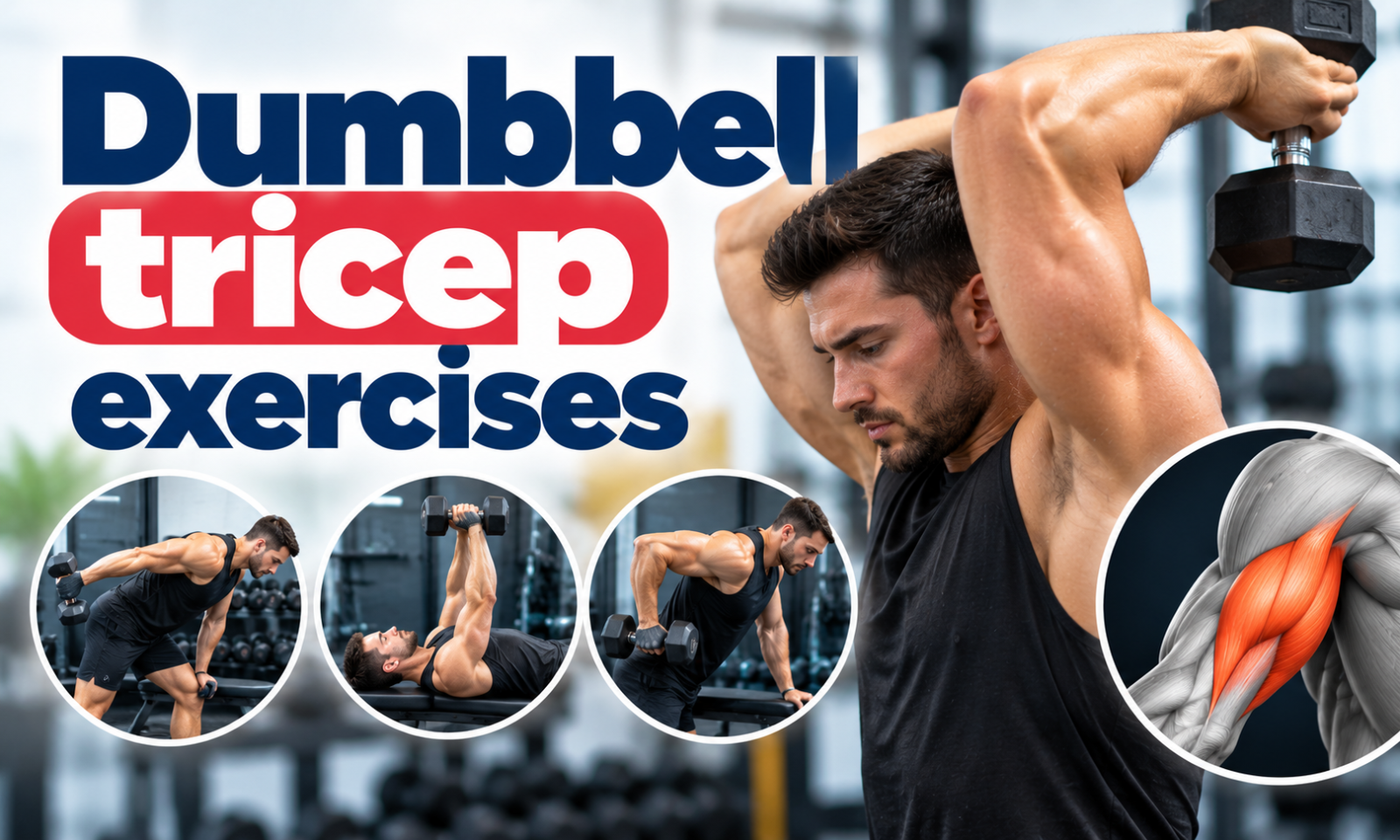
Dumbbell tricep exercises are a simple way to train the muscles on the back of the upper arm without needing a cable machine or a full gym setup. With one or two dumbbells, you can work the triceps through both overhead and pressing movements, adjust the load easily, and train at home or in a fitness center.
The triceps make up a large portion of the upper arm and help straighten the elbow. They also contribute to pushing movements such as presses and push-ups. A small selection of well-performed exercises, progressed over time, is usually more useful than chasing variety.
What Do the Triceps Actually Do?
The triceps brachii has three heads: long, lateral, and medial. All three extend the elbow. The long head also crosses the shoulder, so overhead movements challenge the muscle differently from kickbacks or presses.
| Exercise | Main emphasis | Best for |
| Overhead dumbbell extension | Triceps in a lengthened overhead position | General strength and muscle building |
| Triceps kickback | Strong contraction near elbow lockout | Light-load isolation and control |
| Lying dumbbell triceps extension | Elbow extension with shoulder support | Controlled moderate-load training |
| Close-grip dumbbell floor press | Triceps plus chest and shoulders | Heavier compound pressing |
| Single-arm overhead extension | One side at a time | Addressing side-to-side differences |
| Cross-body dumbbell extension | Single-arm elbow extension | Joint-friendly isolation option |
1. Overhead Dumbbell Triceps Extension
Why it works: The overhead position challenges the long head of the triceps in a stretched position. It can be done seated or standing with one dumbbell.
- Hold one dumbbell securely with both hands and raise it above your head.
- Keep your ribs down and brace your midsection instead of arching your lower back.
- Bend at the elbows and lower the dumbbell behind your head under control.
- Keep the upper arms relatively still, then straighten the elbows to return to the top.
Form tip: Use a load that lets you control the bottom position. If your shoulders feel pinched or you cannot keep your ribs from flaring, reduce the weight or use a single-arm version.
2. Dumbbell Triceps Kickback
The kickback is a lighter isolation exercise for controlled elbow extension. ACE exercise guidance emphasizes keeping the upper arm close to the torso and avoiding low-back arching or torso rotation.
- Hinge forward with a neutral spine and brace your core.
- Bring the upper arm alongside the torso and bend the elbow to roughly 90 degrees.
- Without moving the upper arm, straighten the elbow until the arm is extended.
- Return slowly instead of letting the dumbbell drop.
Kickbacks usually work best with lighter dumbbells and strict form. If you need to swing the weight, it is probably too heavy.
3. Lying Dumbbell Triceps Extension
Lie on a bench or floor with the dumbbells above your shoulders. Bend your elbows and lower the weights toward the sides of your head, then extend the elbows. Keep your wrists stacked and the motion controlled.
Why choose it: Lying down reduces the balance demand and can make it easier to focus on elbow movement. It is also simple to progress by increasing the dumbbell load gradually.
4. Close-Grip Dumbbell Floor Press
This is a compound movement rather than a pure isolation exercise. Lie on the floor with a dumbbell in each hand. Keep the elbows closer to the torso than you would during a wide chest press, lower until the upper arms gently contact the floor, then press the weights upward.
Because the floor limits how far the elbows travel behind the body, some people find this variation comfortable for the shoulders. The chest and front of the shoulders still assist, so think of it as a triceps-focused pressing exercise, not a triceps-only movement.
5. Single-Arm Overhead Dumbbell Extension
Training one arm at a time makes strength differences easier to notice. Hold a light dumbbell overhead, keep the upper arm near the ear, lower the weight behind the head, then straighten the elbow. Match controlled reps on both sides.
If one side is weaker, start with that arm and match the number of repetitions with the stronger side rather than adding extra reps to the stronger arm.
6. Cross-Body Dumbbell Triceps Extension
Lie on your back with one dumbbell above the shoulder. Bend the elbow so the weight travels toward the opposite upper chest, then straighten the arm. Keep the shoulder stable and avoid turning the movement into a press.
How Many Sets and Reps Should You Do?
For general strength and fitness, there is no need for a complicated formula. The CDC guidance for muscle-strengthening activity notes that adults can use resistance exercises such as weight lifting and suggests 8 to 12 repetitions as a practical range for a set, with two or three sets providing additional benefit. Adults are also advised to perform muscle-strengthening activity on at least two days each week as part of an overall program.
| Goal | Sets | Reps | Rest |
| Beginner technique | 1-2 | 8-12 | 60-90 seconds |
| General muscle building | 2-4 | 8-15 | 60-120 seconds |
| Higher-rep accessory work | 2-3 | 12-20 | 45-90 seconds |
Choose two or three triceps movements per workout. A pressing exercise, an overhead exercise, and a lighter isolation movement make a practical combination. The final few reps should feel challenging without breaking form.
A Simple Dumbbell Triceps Workout
| Exercise | Sets x reps | Focus |
| Close-grip dumbbell floor press | 3 x 8-12 | Controlled pressing |
| Overhead dumbbell extension | 3 x 10-15 | Full comfortable range |
| Triceps kickback | 2 x 12-15 | Strict elbow extension |
This session can fit inside a broader upper-body workout. Chest and shoulder presses already train the triceps, so direct arm work should complement the rest of your program.
How Do You Choose the Right Dumbbell Weight?
Choose a load that allows smooth reps with stable shoulders and controlled elbows. Most people can use more weight for a floor press than a kickback, so the same dumbbell does not need to be used for every exercise.
When you can reach the top of your rep range with good form, increase the weight by the smallest practical amount. If the heavier load shortens your range or changes technique, return to the lighter weight.
What Are the Most Common Triceps Training Mistakes?
- Using momentum: swinging the dumbbell reduces the amount of controlled tension on the triceps.
- Letting the elbows drift excessively: some movement is normal, but large changes in upper-arm position can turn an isolation exercise into a different movement.
- Choosing weight over range of motion: a lighter dumbbell used through a comfortable, controlled range is often more productive.
- Training through sharp joint pain: muscle fatigue is expected, but sharp elbow or shoulder pain is a reason to stop and reassess.
- Ignoring the rest of the body: balanced strength training should also include the legs, back, chest, shoulders, and core.
The original Healthline dumbbell arm exercise guide also recommends choosing a weight that allows proper form and allowing recovery time between arm-strengthening sessions.
Can Dumbbell Tricep Exercises Reduce Arm Fat?
Triceps training can build muscle in the upper arm, but it cannot selectively remove fat from that area. Body-fat changes depend on overall energy balance, nutrition, activity, genetics, and other factors. Strength training can improve arm shape and function, but it is not a spot-reduction method.
When Should You Modify or Stop an Exercise?
Stop if you feel sharp pain, sudden weakness, numbness, or an abnormal joint sensation. If you have a shoulder, elbow, wrist, or neck injury, ask a qualified health professional which movements are appropriate. Beginners may also benefit from a trainer checking technique.
Frequently Asked Questions
What is the best dumbbell exercise for triceps?
There is no single best choice. Overhead extensions, close-grip presses, and kickbacks challenge the triceps in different ways, so a combination usually works well.
Can I build triceps using only dumbbells?
Yes. Extensions, kickbacks, and presses can provide enough resistance for progressive training. Consistency, appropriate load, recovery, and nutrition matter more than using a specific machine.
How often should I train triceps?
For many adults, twice-weekly muscle strengthening fits US guidance. Your ideal triceps frequency also depends on other pressing work and recovery.
How many triceps exercises should I do in one workout?
Two or three well-chosen exercises are enough for many recreational lifters. More is not automatically better if fatigue starts to hurt technique.
Are triceps kickbacks effective?
Yes, when performed with strict form and a manageable load. Kickbacks work best as a lighter isolation exercise rather than a maximal-loading movement.
Should I train triceps before or after chest exercises?
If chest strength is the priority, press first and train triceps afterward. If triceps are the priority, place direct arm work earlier as long as it does not compromise heavier lifts.
The Bottom Line
The most useful dumbbell tricep exercises are those you can perform through a comfortable range with stable technique and gradually increasing resistance. Overhead extensions, kickbacks, lying extensions, and close-grip presses provide several options without specialized equipment. Start light, control the movement, and progress consistently.